

MRC-13 Introduces Monad Validator Metadata Registry - Building the Identity Layer
Overview
July 2, 2026. Monad governance has spent much of the recent cycle focused on scale: larger validator sets, validator economics, vote pacing, networking assumptions, and the infrastructure work needed to support more participation. MRC-13 approaches the same growth phase from a different angle.
It is not about making Monad faster. It is about making the validator ecosystem easier to understand.
Context
The proposal introduces a standardized Validator Metadata Registry so validators can publish structured identity and operational information in a form that wallets, explorers, staking applications, dashboards, and analytics platforms can consume consistently.
Validators Are More Than Public Keys
At protocol level, a validator can be represented by cryptographic identity and on-chain state. For users, delegators, institutions, and ecosystem apps, that is not enough.
Operational Impact
A validator is also an operator, an organization, a technical team, a brand, and often a contributor to the broader network. Delegators increasingly want to know who runs the validator, where to find them, what they contribute, and whether they fit the user's own risk and decentralization preferences.
Today that identity layer is fragmented. Some explorers maintain manual mappings. Some staking interfaces rely on separate databases. Some dashboards have to stitch together validator addresses, names, websites, social accounts, and organization records by hand.
Operator Actions
MRC-13 proposes a common language for that information.
A Shared Metadata Layer
Under the proposal, validators would be able to publish structured metadata such as:
- validator name
- website
- logo
- description
- social accounts
- contact information
- additional operational metadata
Risk Watch
That may sound like a quality-of-life improvement, but it becomes more important as the validator field grows. Managing identity for a small early set is one problem. Managing identity across hundreds of validators, multiple staking products, institutional delegation flows, explorers, and wallets is a very different one.
A shared registry gives the ecosystem one reusable source instead of forcing every application to rebuild the same mapping layer.
Why This Matters For Delegation
Delegation decisions are not only about commission, stake size, or raw voting performance. As validator markets mature, users also evaluate operational reputation, ecosystem contribution, infrastructure quality, geographic diversity, and transparency.
A validator metadata registry makes those signals easier to surface inside staking products. Instead of choosing between anonymous addresses, users can see clearer operator context at the point where decisions are actually made.
That also changes incentives for validators. If identity becomes easier to display, validators have more reason to maintain accurate profiles, explain their operations, and present their contribution to the ecosystem professionally.
Why Monad Geo Benefits Directly
The proposal also fits naturally with Monad Geo, because identity is one of the hardest parts of infrastructure analytics.
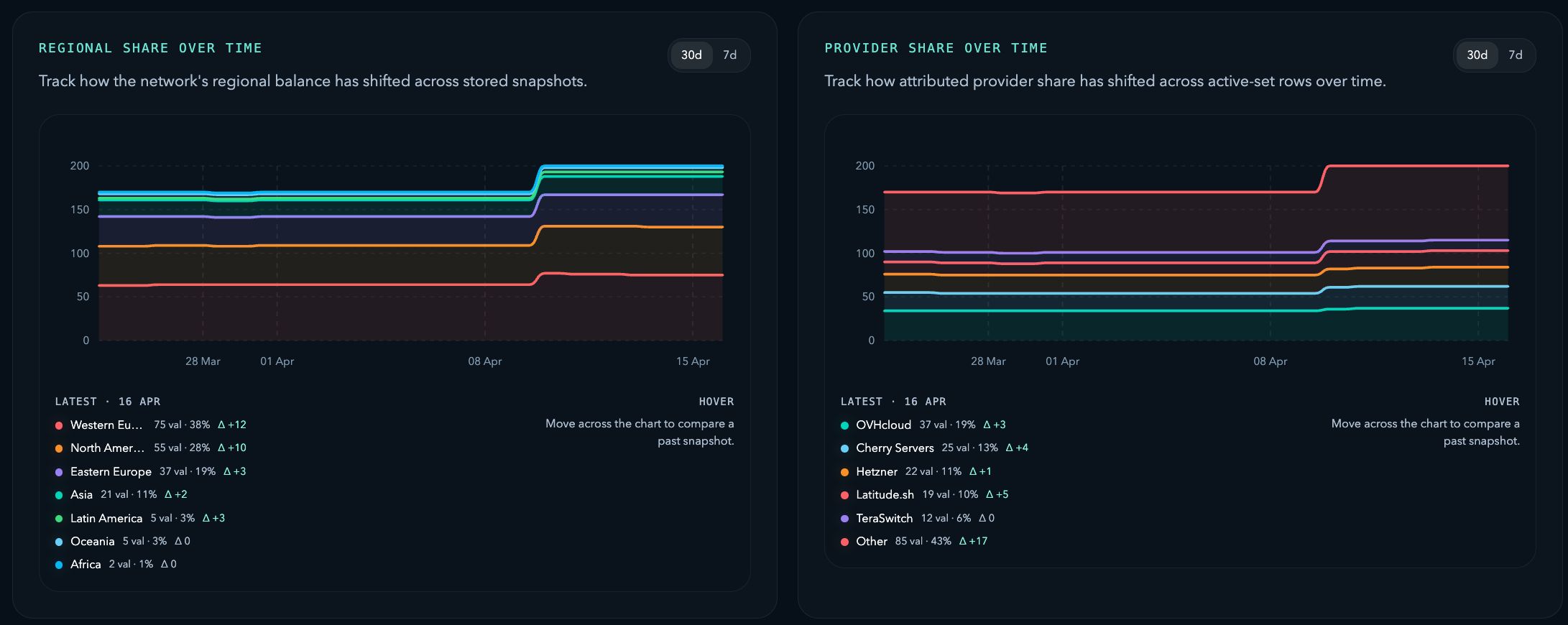
Dashboards can already analyze geography, hosting providers, regional concentration, validator growth, and staking distribution. But the richer question is not only where validators are. It is who they are, what they operate, and how their identity connects to the infrastructure footprint.
A standardized metadata registry would let analytics products combine verified validator identity with network structure. That creates a much more useful intelligence layer for delegators, researchers, foundations, wallets, and operators.
More Than Branding
It would be easy to dismiss MRC-13 as a way to attach names and logos to validators. That misses the larger point.
Metadata becomes infrastructure once the ecosystem starts building on it. A shared registry can support validator directories, delegation recommendation engines, governance dashboards, operator reputation systems, ecosystem maps, and more advanced infrastructure analytics.
That is the real value: every application can innovate on top of a common identity layer instead of maintaining its own private spreadsheet of who is who.
Bottom Line
MRC-13 will not increase TPS, reduce block times, or change staking rewards.
But it addresses something every growing validator ecosystem eventually needs: identity.
As Monad expands toward larger validator sets and broader delegation participation, understanding who operates the network becomes just as important as understanding how the network operates. For BitCtrl, that fits the same thesis behind Monad Geo: validator infrastructure should be reliable, measurable, and easy to navigate.
The stronger the identity layer becomes, the stronger the validator ecosystem becomes around it.
- MRC-13 proposes a standardized validator metadata registry for Monad.
- The registry would help wallets, explorers, staking apps, and dashboards display validator identity consistently.
- Better metadata can improve delegation decisions by adding operator context beyond address, stake, and commission.
- Monad Geo could combine registry data with infrastructure analytics to create richer validator intelligence.