


Monad Moves Toward 300 Validators - And Why Placement Now Matters as Much as Growth
Overview
April 16, 2026. Monad's validator ecosystem is entering a more interesting phase. The newest draft of MIP-9 now proposes increasing the maximum active validator set from 200 to 300, while MIP-11 introduces a separate but related change to validator economics by automatically routing priority fees into validator staking pools for delegators.
Taken together, these two conversations point to the same conclusion: Monad is not just preparing to get larger. It is preparing to decide how a larger validator set should compete, earn, and distribute across the network.
MIP-9 Turns Expansion into a Design Question
Context
The most concrete shift is in MIP-9 itself. The current draft says ACTIVE_VALSET_SIZE should increase from 200 to 300, a roughly 50% step-up in active-set capacity. The rationale is straightforward: make room for more decentralization without forcing a much larger, riskier single jump in consensus-layer complexity all at once.
That matters because validator demand is already visible. Mainnet and testnet data both suggest operators are onboarding faster than they are being activated. In practice, expansion is not solving a shortage of interest. It is unlocking participation for a validator base that is already forming.
The Important Question Is No Longer Count Alone
Operational Impact
At this point, growth by itself is not enough. If the next hundred validators arrive through the same hosting corridors, the same countries, and the same provider paths, the network will be larger without being proportionately harder to disrupt. Count goes up, but structural concentration remains.
That is why placement matters as much as growth now. The next validator wave can either reinforce the current map or improve it.
MIP-11 Changes the Economics of a Larger Set
Operator Actions
One important clarification: MIP-11 is not a governance-scaling proposal. The forum draft is about automatic priority fee distribution. Instead of priority fees going directly to a validator's beneficiary address, the proposal would route those fees into the validator's staking pool at the end of each block.
That still matters for active-set expansion because it changes how validators compete for stake and how delegators participate in upside as the field gets larger. Capacity and economics are different levers, but they are converging at the same moment.
The Missing Layer Is Visibility
Risk Watch
This is where Monad Geo becomes useful. Once operators can see regional concentration, country exposure, and provider overlap in one place, expansion stops being a vague decentralization talking point and becomes a measurable placement problem.
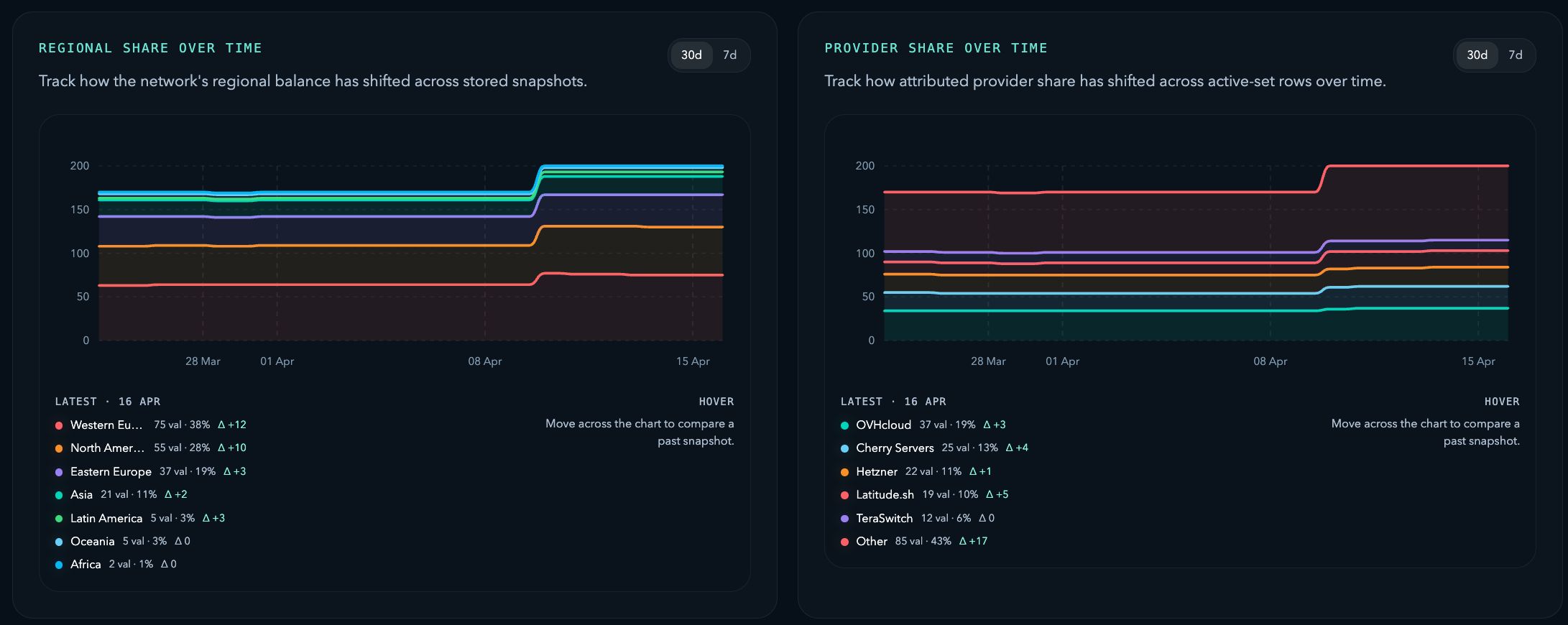
The live Monad Geo dashboard makes the practical question easier to answer:
- which regions are already dense enough that new validators should arrive through different providers
- which countries are meaningful but still locally concentrated
- where the next deployment can improve resilience rather than simply increase count
That is the difference between expansion that adds size and expansion that improves structure.
Why This Moment Matters
Monad is entering a phase where the validator set can be shaped deliberately instead of reactively. MIP-9 defines how large the active set can become. MIP-11 affects how value is distributed inside that larger set. Monad Geo provides the visibility needed to place new validators where they strengthen the network most.
That combination is what makes this moment strategically important. The next validator wave will not just expand Monad. It will determine how well the network is distributed once that expansion lands.
Sources
- Monad forum: MIP-9 active set increase
- Monad forum: MIP-11 automatic priority fee distribution
- BitCtrl Monad Geo dashboard
- MIP-9's current draft increases Monad's active validator set from 200 to 300, turning expansion into a live design question.
- Validator demand is already strong, so the problem is allocation of seats rather than attraction of new operators.
- MIP-11 would automatically distribute priority fees into staking pools, changing delegator economics as the validator field grows.
- Monad Geo provides the placement visibility needed to make new validator slots improve structure, not just size.