


Monad Mainnet Validator Pipeline Is Filling Ahead of Active-Set Expansion
Overview
Written on April 7, 2026 from a Monad Geo data snapshot taken on April 6 at 18:00 UTC. The headline shift is structural rather than dramatic: Monad mainnet now shows 211 total validators, 170 active validators, and 41 validators queued outside the active set. That means nearly 1 in 5 validators is currently waiting for participation, which is the clearest signal that the network is building depth before the next expansion phase.
This is not a demand problem. It is a selection problem. Monad already has operators moving through the VDP, joining the queue, and positioning for activation. The strategic question is no longer whether the network can attract validators. It is which queued validators most improve decentralization once new active slots open.
Pipeline View: Capacity vs Demand
Context
A useful way to read the pipeline today is:
- 170 active validators
- 41 queued validators
- 39 open slots to the current 200-validator cap
- +50 additional slots if `MIP-9` raises the cap to 250
That framing matters because validator demand is already ahead of participation. Expansion is now a governance and network-quality choice, not an emergency response to weak supply.
Regional and Country Concentration
Operational Impact
The current queue is easier to understand when read against the live Monad Geo dashboard, which tracks how validator geography and provider mix are distributed underneath the headline count. The two screenshots below show the most important split: regions remain dominated by three core clusters, while country-level distribution reveals where the next active validators could improve decentralization most.
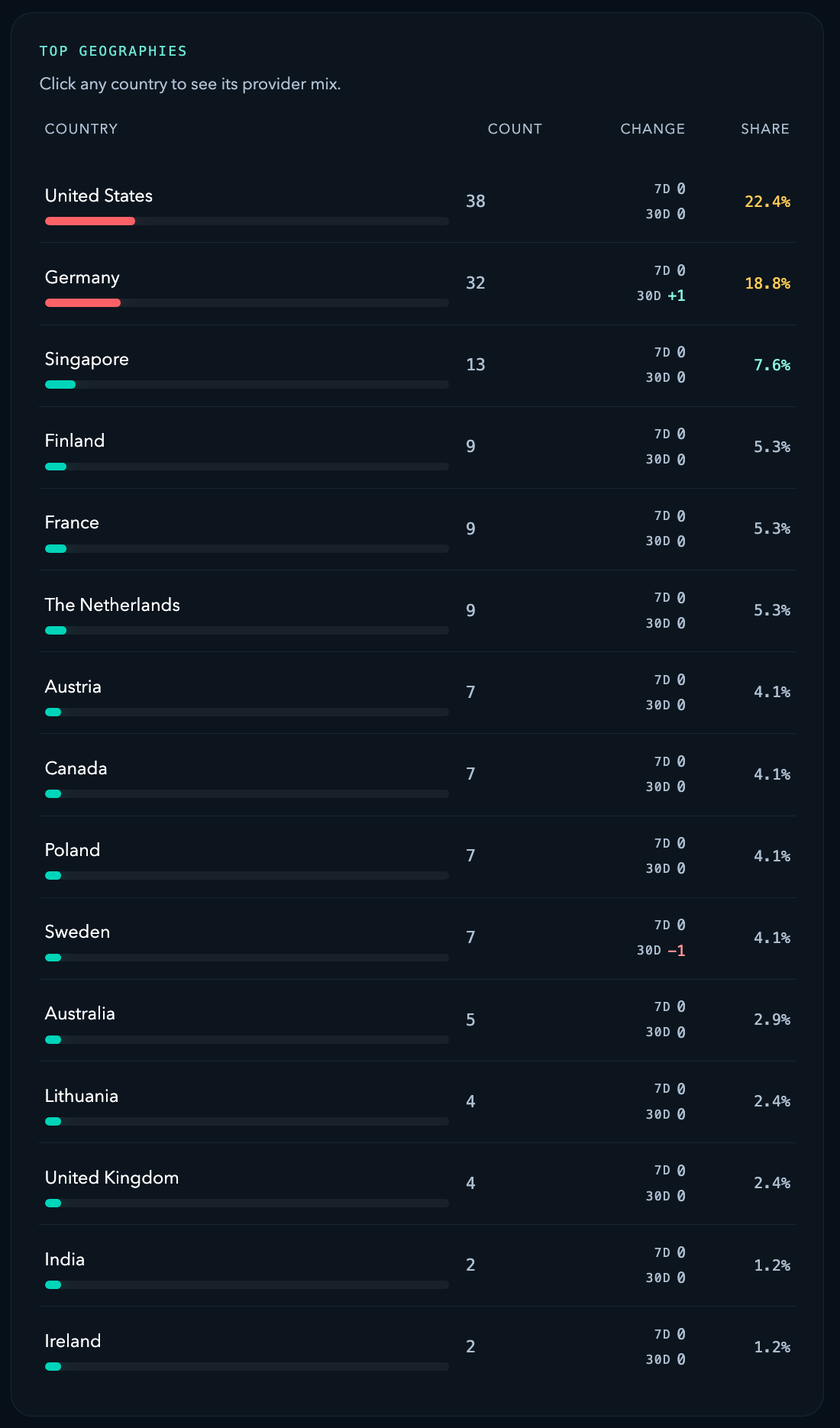
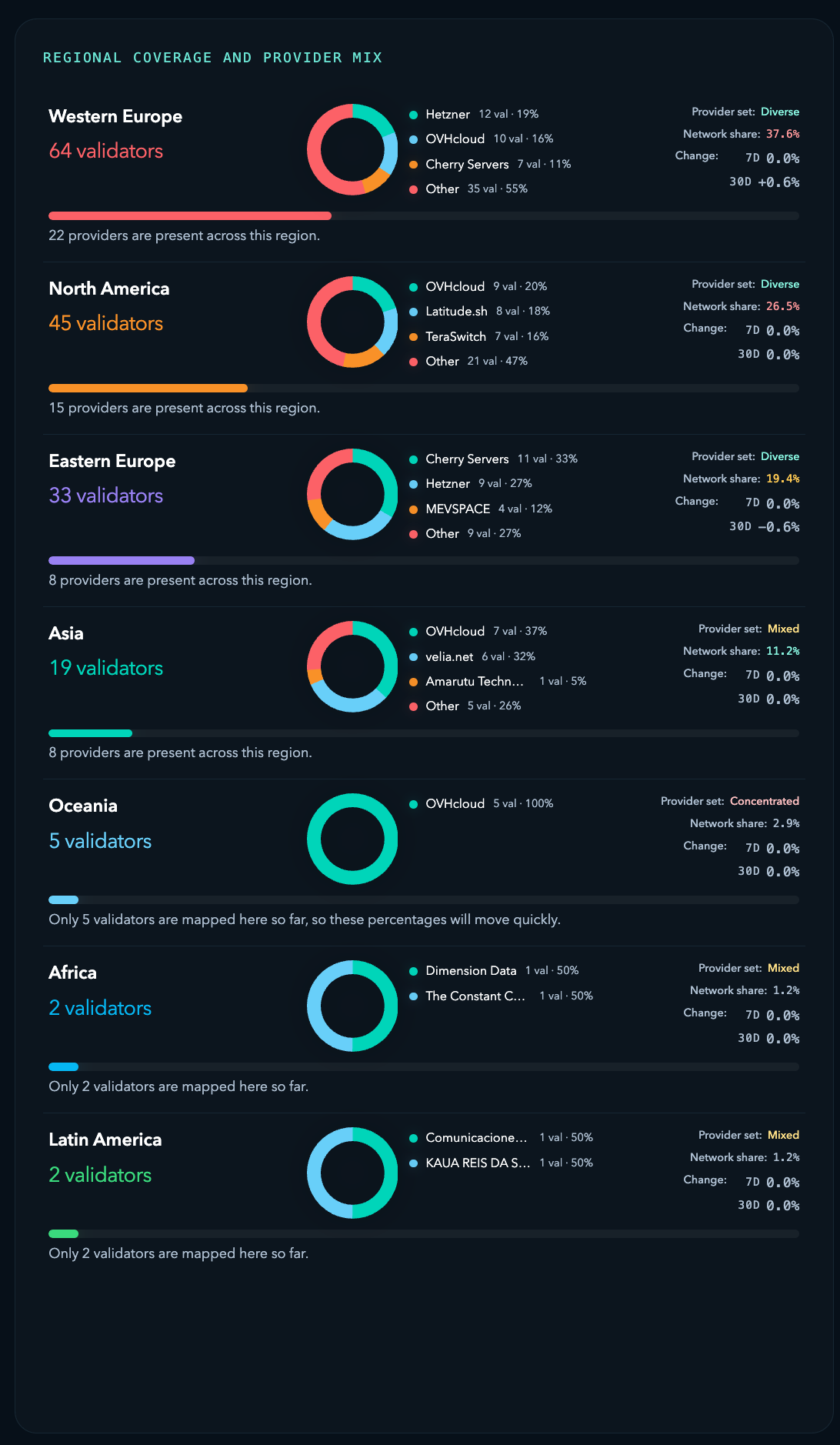
On the regional layer, Western Europe, North America, and Eastern Europe still account for 83.5% of visible share. That is a strong operational base, but it is not the same thing as finished decentralization. Regions such as Asia, Oceania, Africa, and Latin America still offer the highest leverage if Monad wants future active-set growth to improve balance rather than just lift the topline validator count.
Operator Actions
At the country layer, the picture is healthier than a single-market network, but still uneven underneath. The United States leads with 22.4% of visible share, Germany follows with 18.8%, and Singapore holds 7.6%. Several other countries already have meaningful representation, but the provider mix inside some of those countries is still highly concentrated. That means future activation decisions can improve network quality even without dramatic geographic expansion.
Why the Queue Matters More Than the Count
The recent intake wave sharpens this point. Monad added 23 validators over 30 days, and 19 of those arrivals came in just the last 7 days. Almost all of that newest intake is still inactive, and much of it remains unmapped on provider and location metadata. In practical terms, the visible decentralization profile can change quickly as those records settle and validators move toward participation.
Risk Watch
This is where VDP and MIP-9 intersect. The VDP is clearly producing operator supply ahead of activation, while MIP-9 would expand the path from approval to participation if active-set growth advances. Together, they imply a network that is preparing to choose higher-quality decentralization rather than simply accumulating more validator names.
Sources
- Monad mainnet now shows 211 total validators, 170 active, and 41 queued outside the active set.
- Recent validator growth is outpacing activation, which points to deliberate pipeline building rather than weak demand.
- Regional coverage is strong on the surface, but several countries and clusters still need better provider balance.
- The next phase depends less on raw validator count and more on which queued validators improve decentralization.