


Monad Testnet Stress Test - First Real Signal of Network Performance at Scale
Overview
April 13, 2026. Following up on the epoch 503 stress test, Monad Foundation said the network sustained 10,000+ native TPS for roughly eight hours and processed hundreds of millions of transactions. That is a much stronger and clearer signal than a one-off benchmark burst because it reflects live validator participation over a long window rather than a short synthetic peak.
The original chart readout already showed a healthy ramp, stable block timing, and controlled fee behavior. The new follow-up note sharpens the interpretation: this was not only a throughput demonstration, it was an endurance test for validator performance under real load.
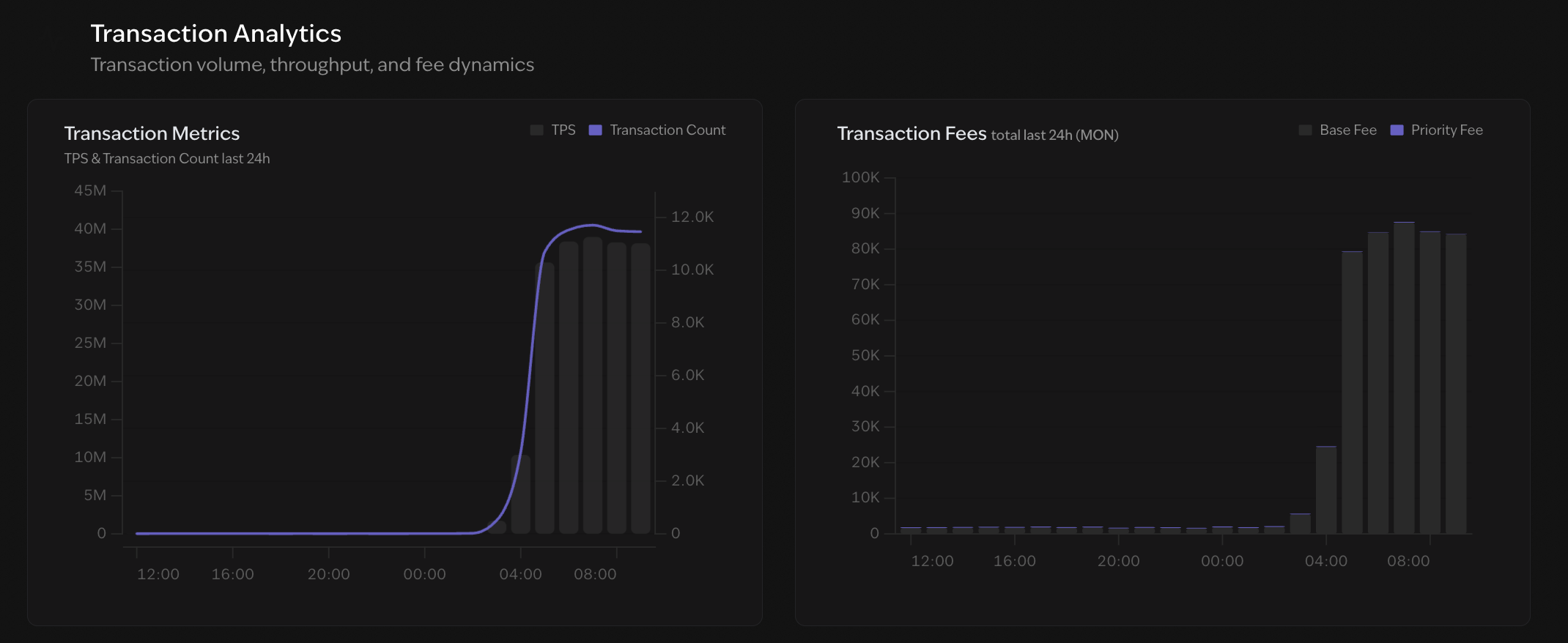
Chart reference from the live gmonads charts dashboard, used here to illustrate epoch 503 throughput, block timing, and fee behavior under load.
Foundation Follow-Up: What Changed the Read on This Test
Context
The most important addition from the follow-up note is scale and duration. Monad Foundation described the run as sustaining 10k+ TPS (native) for about 8 hours during epoch 503, which puts the exercise firmly in the category of sustained load rather than a short-lived spike. The same note also says the network processed hundreds of millions of transactions across the run.
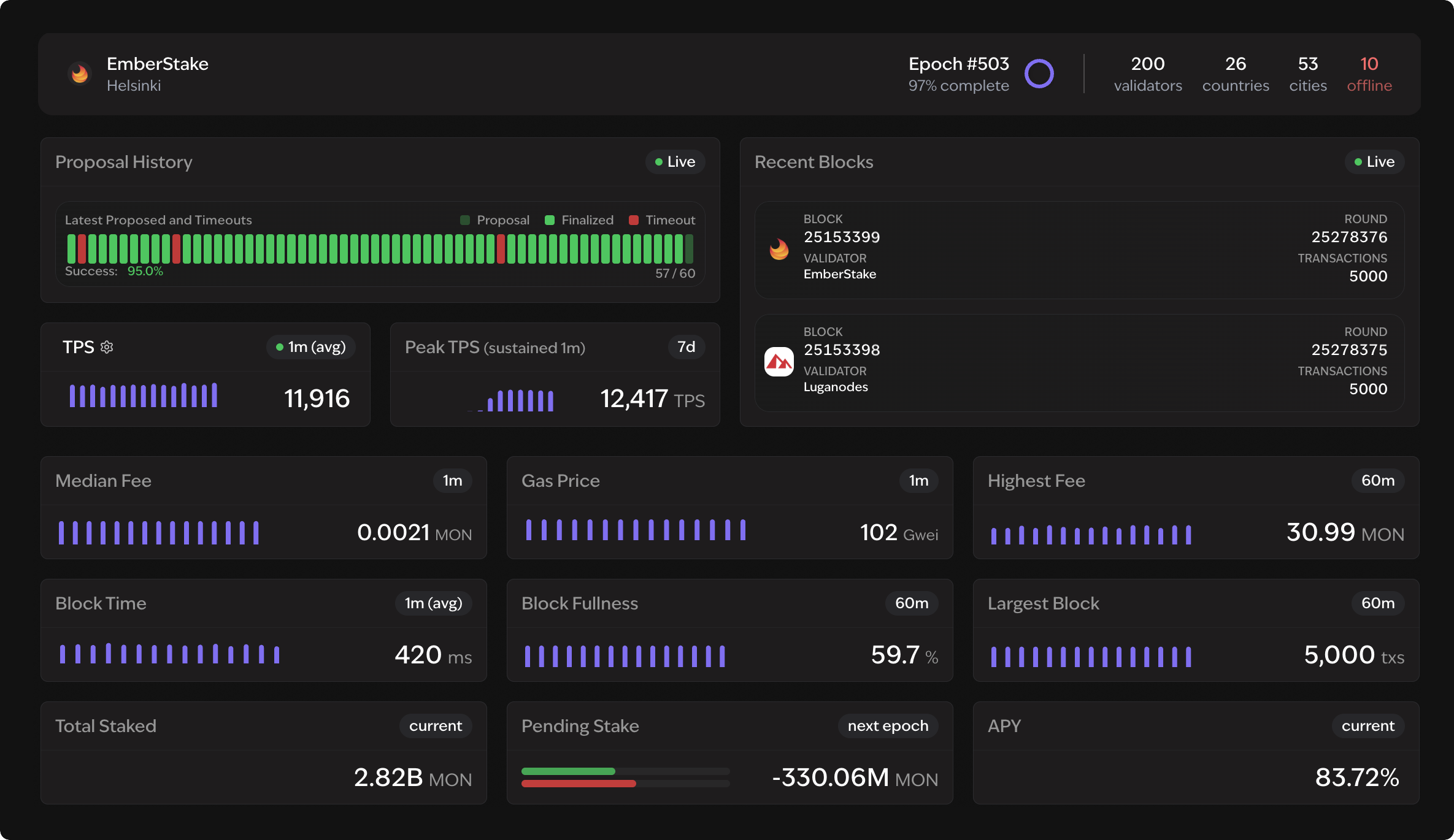
In the final phase, operators introduced ERC-20 load, which pushed block utilization to near 100%. That matters because it extends the interpretation of the test from simple transaction pressure into a more application-like load pattern. In other words, the network was not only busy; it was busy in a way that looked more like future real-world usage.
The Strongest Signal May Be Validator Resilience
Operational Impact
The headline throughput number is useful, but the stronger operational signal may be validator behavior. Foundation said more than 90% of validators did not experience a single timeout during the run. That is a meaningful result because it argues against a familiar tradeoff. The test did not simply show high throughput; it suggested that throughput and decentralization quality can hold together under pressure.
That point matters more than marketing optics. If a network has to sacrifice broad validator performance to hit headline throughput, then the benchmark is less useful. This result points in the other direction: most of the decentralized operator set stayed stable while the network was being pushed much harder than usual.
Operator Actions
BitCtrl's own validator also came through the run cleanly, with no timeouts recorded and 100% uptime maintained through the exercise. That is exactly the kind of resilient behavior operators want to see from a tuned production-grade setup when the network is being stressed for hours rather than minutes.
Some Validator Issues Are the Useful Part
Not every validator came through cleanly, and that is exactly why the exercise matters. Foundation explicitly encouraged operators to review logs and metrics to identify where improvement is still needed. That should be read as part of the test objective, not as a footnote.
Risk Watch
The practical post-test checklist is still the same:
- inspect CPU saturation and memory pressure
- check TrieDB and NVMe latency for load-related spikes
- review peer behavior and networking responsiveness
- compare timeouts, sync behavior, and block timing against your own telemetry
This is where validator maturity shows up. The value of a coordinated load event is not just that the network survives it. The value is that every operator leaves it with a better understanding of where their setup bends first.
Why This Sets the Baseline for What Comes Next
Monad Foundation closed the note by thanking validators for participating and giving explicit credit to the Category Labs team for the progress since the last test. That framing matters. It positions epoch 503 as a milestone in an iteration cycle, not as the final answer.
The practical takeaway is straightforward: this run is now the baseline. Future stress tests will matter less for whether Monad can generate another large headline and more for how much of the validator set improves from one run to the next.
Sources
- Foundation follow-up says Monad testnet sustained more than 10,000 native TPS for roughly 8 hours during epoch 503.
- The final phase added ERC-20 load and drove block utilization close to 100 percent.
- More than 90 percent of validators reportedly completed the run without a single timeout, and BitCtrl's own validator finished with no timeouts and 100 percent uptime.
- The remaining validator issues are the useful part of the exercise because they create a concrete optimization checklist before the next test.