


FastLane Expands Monad Liquid Staking - A New Layered Model for Yield and Validator Growth
Overview
April 25, 2026. Monad's staking ecosystem is starting to look more intentional, and FastLane is one of the clearest places where that change is visible. What began as a more familiar liquid staking setup around shMON is now moving toward a layered model that separates liquidity from yield while still keeping both tied to validator growth.
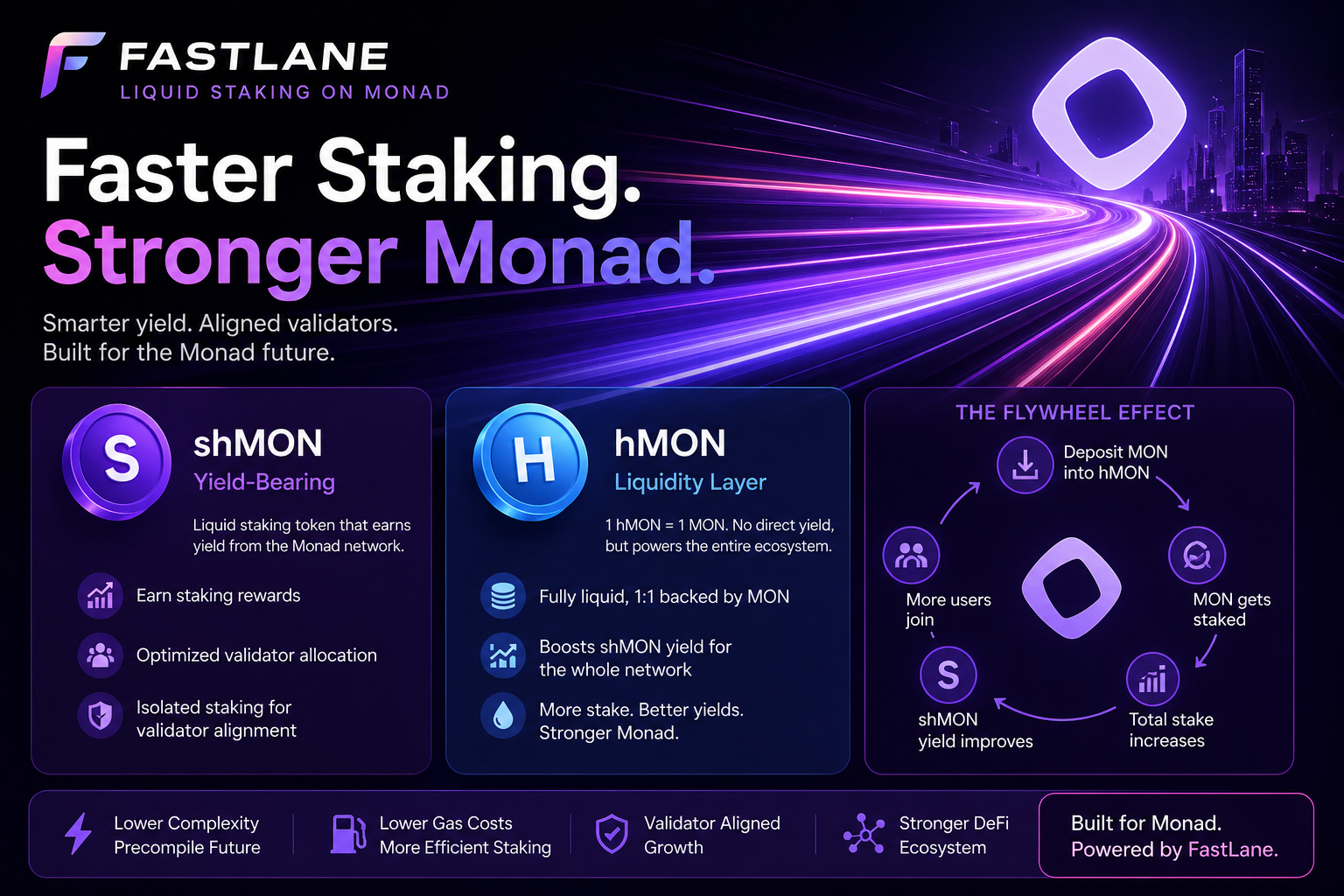
That distinction matters because the live docs already show the underlying structure. shMON is the yield-bearing tokenized staking position, documented as an ERC4626-style liquid staking token whose value rises as staking rewards, MEV revenue, and atomic unstaking fees accrue. At the same time, FastLane also documents a zero-yield deposit path that adds MON into the protocol without minting shMON immediately. The article-level framing around hMON is best understood as a cleaner product layer built on top of that second path.
shMON Is Still the Yield Engine
Context
FastLane's docs remain clear that shMON is the productive side of the system. Users deposit MON and receive a liquid token that auto-compounds as protocol revenue arrives. That revenue does not come from staking rewards alone. FastLane also points to MEV flows and other validator-adjacent revenue sources, which makes shMON more than a simple wrapped staking receipt.
The other useful detail is how flexible the staking path has become. The docs describe policy-based bonding, isolated controls, and validator-facing integrations, all of which make stake routing more intentional. That does not just help stakers express different preferences. It also makes validator alignment more direct, because capital can be bonded and managed in a way that is less purely generic than older pooled staking designs.
The Second Layer Changes the Economics
Operational Impact
The more interesting development is the non-yield side. FastLane's deposit-path docs describe a zero-yield tranche where users add MON to the protocol, do not receive shMON immediately, and instead increase the yield earned by existing shMON holders. In other words, one side of the system can stay liquid or strategically parked while the other side captures the improved rewards.
That is why the hMON framing matters. If FastLane wraps that zero-yield side into a more explicit liquid token, the model becomes easier for DeFi, treasury, and incentive design to use. Instead of every participant taking the exact same yield-bearing position, the protocol can support distinct capital roles: a yield-seeking layer and a liquidity-support layer. The result is a more deliberate staking economy rather than a one-size-fits-all pool.
Why Validators Care
Operator Actions
For validators, including BitCtrl, this is not just another DeFi product. It changes how delegation and validator exposure can grow through ecosystem activity. If FastLane usage expands, more capital can flow into the staking base, shMON yields can improve, and validator allocation can become more dynamic than a simple static delegation path.
That makes the model strategically interesting for Monad. It links three things that are often treated separately: liquidity, yield, and validator growth. If adoption reaches real scale, the outcome is not only more staking volume, but a more active relationship between DeFi participation and validator stake distribution.
What To Watch Next
Risk Watch
The next question is not whether the structure is clever enough on paper. It is whether it gets distribution. FastLane needs broad integration for the flywheel to become meaningful: wallets, protocols, treasuries, and validators all need to participate in the same loop. If they do, Monad gets something stronger than another staking product. It gets a staking system where one layer of capital can improve the efficiency of another, while validators still sit at the center of the flow.
- FastLane's current docs already support shMON plus a separate zero-yield deposit path, which is the foundation for the hMON-style second layer.
- shMON remains the yield-bearing core, with rewards sourced from staking, MEV flows, and atomic unstaking fees.
- A non-yield liquid layer can raise total staked MON and improve shMON holder yield without forcing every depositor into the same position.
- BitCtrl participates on the validator side of this flow, so broader FastLane adoption could influence both DeFi liquidity and validator stake distribution.