


Category Labs announced Quantum Cadence on 27 October, presenting a post-quantum version of its Cadence consensus protocol. The design removes quorum certificates and makes consensus safety and liveness independent of digital signatures. Category Labs says an early prototype is running on an internal test network. Its announcement does not establish a Monad mainnet or public-testnet rollout. Announcement.
The accompanying paper, first submitted on 23 October, is by Mohammad Mussadiq Jalalzai, Tobias Klenze and Jovan Komatovic. It describes the new slot-consensus protocol and its fallback, alongside changes still needed elsewhere in the framework. Paper.
Why changing signatures is not a simple swap
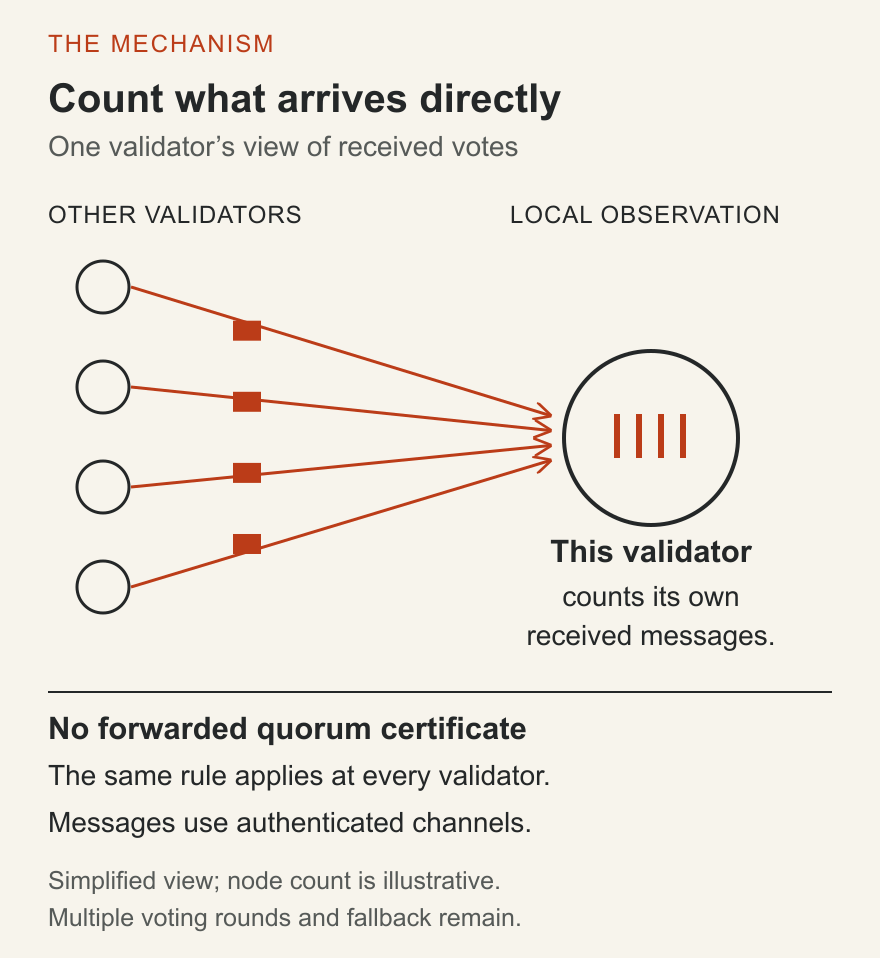
A quorum certificate is portable evidence that enough validators have voted for something. Other validators can verify that evidence when it reaches them. In systems using BLS, many signatures can be combined into a compact aggregate, keeping the certificate small enough to circulate frequently.
A sufficiently powerful quantum computer could break that signature scheme. Post-quantum signatures address a different set of cryptographic assumptions, but substituting them creates a networking problem: the signatures are larger, and comparably compact, fast aggregation is not available in the design described by the authors. A certificate containing many individual signatures becomes expensive when every validator repeatedly broadcasts it. Interactive explainer.
Quantum Cadence changes how agreement is established to avoid that repeated certificate traffic.
The same slots, with validators counting for themselves
Cadence lets several validators propose material for each block. It divides work into slots, each with its own consensus instance. Several slots can progress together because a new instance does not have to wait for the preceding block to finish. That overlap is the basis of Cadence’s pipelining; a short interval between slots is distinct from the time required to finalize a block. Cadence paper.
Quantum Cadence retains this architecture and replaces Chorus, the protocol that agrees on a slot’s block, with Quantum Chorus. Each validator counts support in messages it has received directly, instead of relying on another validator to forward proof of a quorum. The normal fast path still consists of proposal dissemination followed by two voting rounds. Quantum Cadence overview.
When that path cannot finish, Coda provides fallback agreement for multiple proposers. It builds on Forget-IT, an earlier consensus protocol co-developed by Category Labs researchers. Forget-IT’s authors are Ittai Abraham, Sourav Das, Yuval Efron and Jovan Komatovic. Coda adapts that line of work to the needs of Quantum Chorus. Forget-IT, Quantum Cadence paper.
Signatures still provide evidence of misconduct
Safety means correct validators do not finalize conflicting outcomes. Liveness means the protocol can eventually make progress under its operating assumptions. Removing signatures from those guarantees does not remove authentication: the model still requires authenticated channels, collision-resistant hashing, synchronized clocks and partial synchrony. It permits at most f Byzantine validators among 3f + 1 participants. Model and assumptions.
Validators still use post-quantum signatures for accountability—evidence that a participant misbehaved, such as signing conflicting votes. The distinction is between reaching agreement and proving misconduct to someone else. Quantum Chorus limits a validator to at most two signed votes per slot, covering all proposers; Coda uses no signatures. That vote count should not be confused with a count of every message a validator sends. Design overview.
What the simulations show
The performance comparison concerns Quantum Chorus and Chorus, the two designs’ slot-consensus components. The setup uses 200 equal-stake validators, each with a 1 Gbps link, and geographic placement based on Monad’s validator distribution. Slots begin every 100 milliseconds and contain 500 KB of proposal data. Those are simulation inputs, not new live-network specifications. Simulation methodology.
The authors report comparable latency and better scaling as the number of proposers increases. The mechanism behind that result is understandable: Quantum Chorus does not attach a separate signature or certificate for every proposer to each vote. The comparison varies proposer count; it does not demonstrate the same improvement from increasing the validator count.
The figures below redraw the original explainer’s rounded values at eight proposer counts. Quantum Chorus uses ML-DSA-44 signatures of 2,420 bytes; Chorus uses BLS. The finality values are means from 200 trials at each proposer count. Lines connect the displayed points; the source chart supplies no uncertainty intervals. Original charts and methodology.
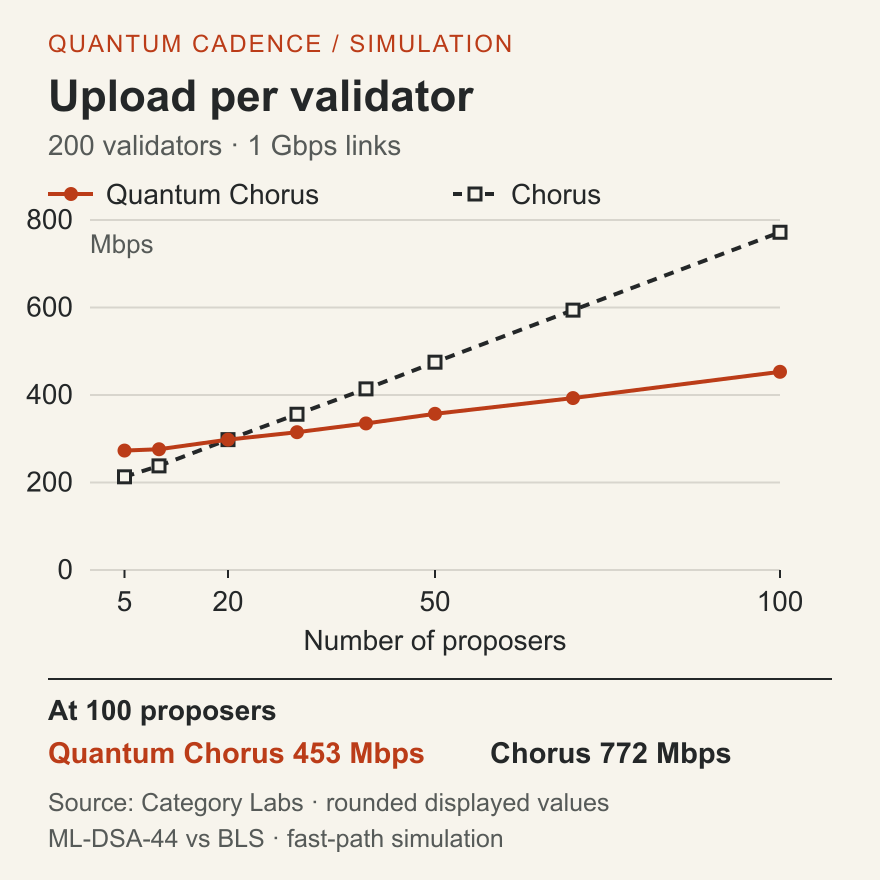
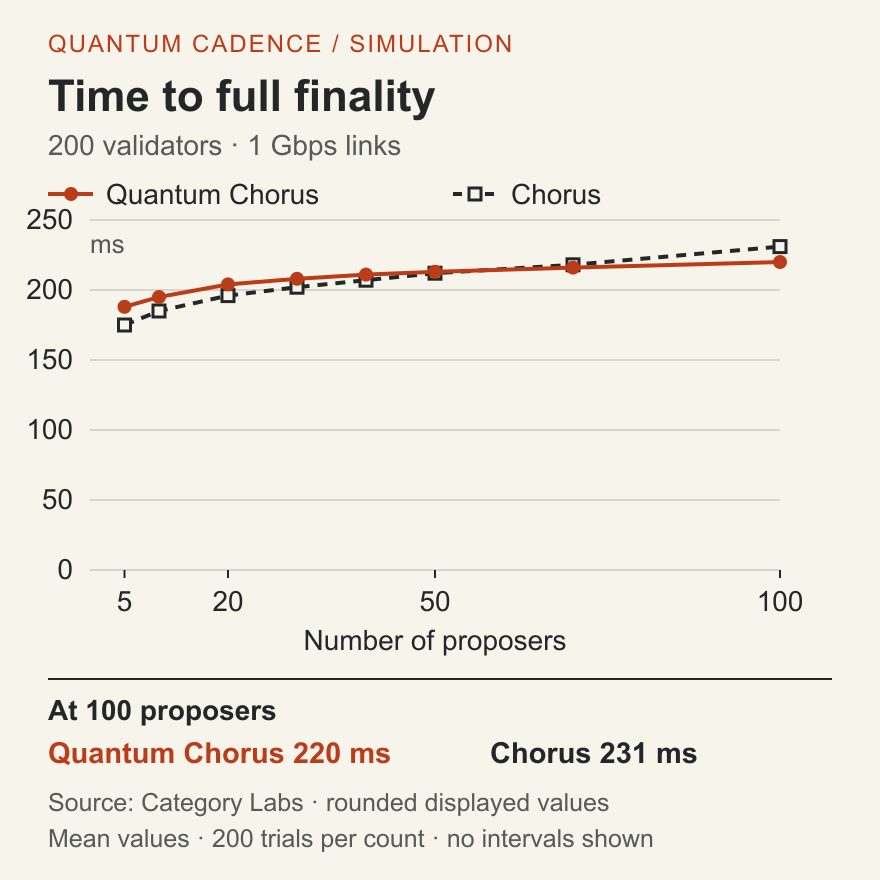
The limits matter. The simulation models network propagation, transmission and queueing, but excludes local computation. It runs the fast path without faults or message loss. It therefore does not establish performance during failures or the full computational cost of a production implementation. Larger signatures can also require more bandwidth when there are few proposers, so the result is not a universal reduction in bandwidth or latency. Performance explainer, evaluation.
An internal prototype, with further work identified
Category Labs says AI adapted its existing Cadence prototype in a few hours, helped by the shared architecture. That is the team’s account of a prototype port. It is not evidence that AI designed the protocol or that the implementation has passed an independent security review. Announcement.
Paper v1 outlines changes to Conductor, the component that schedules slots, while leaving its full specification and analysis to later work. It also excludes proposal hiding—preventing a proposer from reacting to others’ proposals—and external finality proofs for light clients and bridges from its scope. These boundaries make a blanket claim that every Cadence guarantee has already carried over too broad. Paper scope.
The release provides a consensus design to examine and an internal implementation to develop further. It does not, by itself, migrate wallet signatures, transaction authorization or every other blockchain component to post-quantum security. A production deployment and an entire-chain security claim would each require additional evidence.
Sources
- Category Labs announcement — 27 October 2026
- Quantum Cadence interactive explainer
- Performance and simulation methodology
- Quantum Cadence paper — v1, submitted 23 October 2026
- Cadence paper — v2
- Forget-IT — Cryptology ePrint Archive
- Quantum Cadence replaces quorum certificates with validators counting messages they receive directly.
- Signatures remain for accountability; safety and liveness rely on the protocol’s stated model instead.
- Reported performance comes from fast-path simulations with 200 validators, excluding faults and local computation.
- Category Labs reports an internal prototype; Conductor work remains, and no public-network rollout is established.