


On 4 November 2026, Ubuntu published a fix for an APT vulnerability that could allow an attacker to replace a package during installation and execute code as root. Monad Foundation's MF-8 notice, dated 5 November, marked the issue Code Orange and recommended that operators act at their earliest convenience. The issue is in the operating system's package tooling; it is not a vulnerability in the Monad protocol itself.
Ubuntu rates CVE-2026-109518 high severity, with a CVSS 4.0 score of 7.7. A successful attack on a validator host could give an attacker root access, potentially exposing anything accessible to that host. The announcement and advisory do not establish that any particular Monad node has been compromised or patched.
How the package check can fail
The attack requires particular conditions. When an unpatched APT client installs a package over HTTP, an attacker able to interfere with that traffic, including a malicious mirror or proxy, may exploit how APT reuses hard links when a download is redirected and retried. Ubuntu says this can result in an unverified, attacker-controlled package being installed despite the normal archive verification protections. Package installation can execute scripts with root privileges. Ubuntu's explanation covers the mechanism and mitigation.
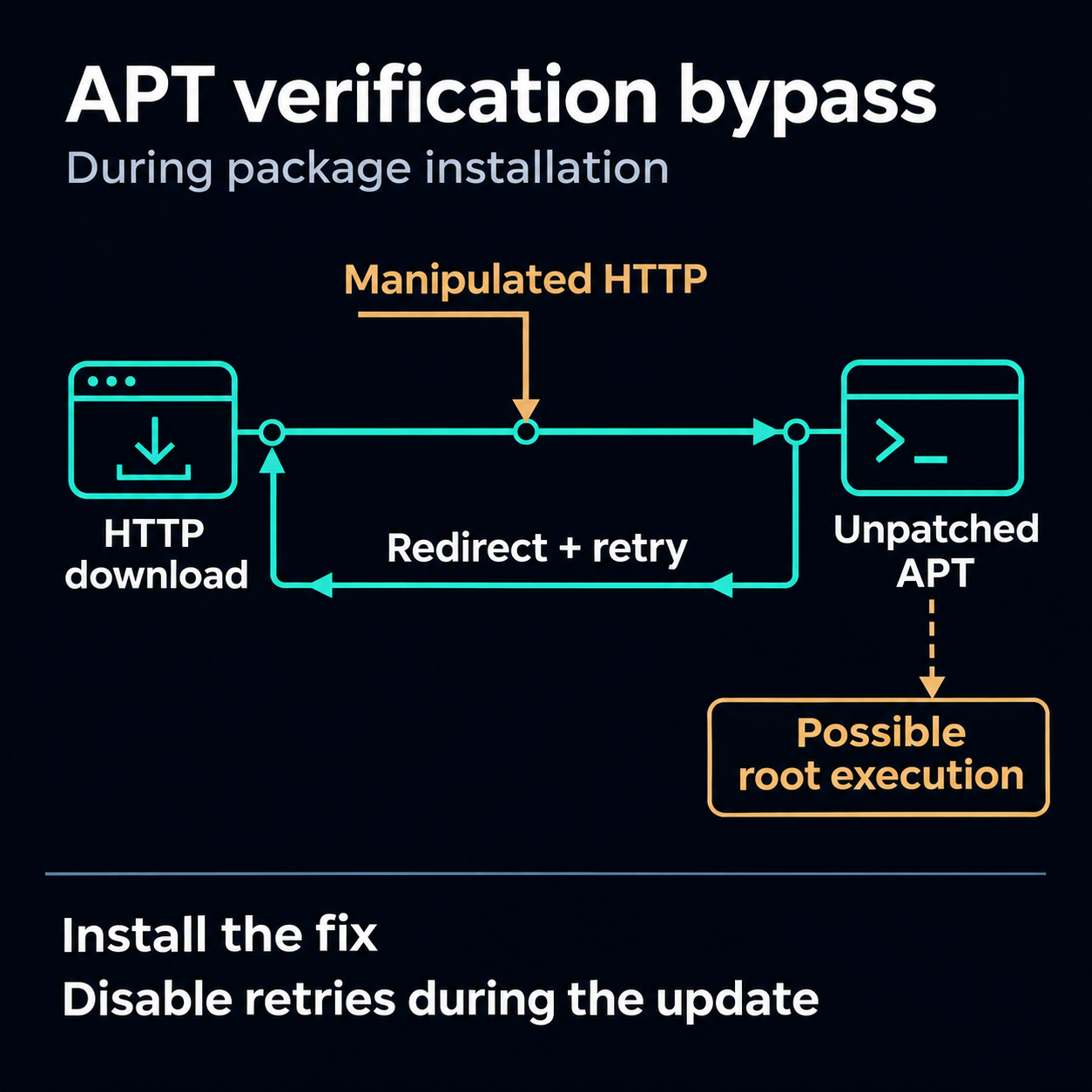
BitCtrl editorial graphic; source: Ubuntu security guidance.
Ubuntu 22.04 LTS and newer have the relevant nonzero retry setting by default. Older releases are affected if retries have been configured to a nonzero value. This issue affects APT-based tools; Ubuntu says snap installation uses a different package system.
Check the release and installed version
On each relevant Ubuntu host, identify the release and the installed packages built from the APT source. The package-selection commands below use APT search patterns, supported from APT 2.0; older installations need version-appropriate instructions. The retry setting helps assess exposure, but an empty configuration result should not be treated as proof that a host is patched.
cat /etc/os-release
apt list --installed '?source-package(^apt$)'
apt-config dump | grep -i 'Acquire::Retries'
df -h / /var /var/cache/apt/archives
Compare the installed versions with Ubuntu's security notice. The listed fixed APT source-package versions for currently supported releases are:
- Ubuntu 22.04 LTS:
2.4.15ubuntu0.1 - Ubuntu 24.04 LTS:
2.8.4ubuntu0.1 - Ubuntu 26.04 LTS:
3.2.1ubuntu0.1 - Ubuntu 26.10:
3.3.3ubuntu0.1
A later applicable package version is acceptable; use Debian package version ordering rather than a simple text comparison. Ubuntu lists fixes for older releases through Ubuntu Pro and, for some releases, its Legacy Support add-on. Availability can depend on the host's repositories and support status. If the result is unclear, check the candidate versions and holds before making changes.
Patch with the node's maintenance plan in mind
Ubuntu recommends upgrading all packages with apt upgrade. Its alternative for systems where that is not practical is to upgrade the installed packages built from the APT source, with retries disabled during the installation. Monad Foundation's announcement includes both approaches. For a validator, inspect the proposed transaction and choose the appropriate maintenance procedure for that deployment. A targeted transaction can still update multiple related packages and dependencies; simulation is a preview, not a guarantee of no service impact.
First refresh the package indexes. The extra option disables retries for this command as well:
sudo apt update -o Acquire::Retries=0Read the output before proceeding. If any repository fails or indexes cannot be refreshed, resolve the problem first; an update can leave older indexes in use. Then preview the targeted transaction:
sudo apt install --simulate -o Acquire::Retries=0 --only-upgrade '?source-package(^apt$)'Review package removals, unexpected dependencies and held packages. If the proposal is appropriate for the system, apply the targeted update:
sudo apt install -o Acquire::Retries=0 --only-upgrade '?source-package(^apt$)'Rerun the installed-package check and compare the result with the correct release's fixed versions. Check the validator's usual health, synchronization and participation signals after the change. No specific service restart or reboot can be prescribed without knowing the deployment and transaction. A pre-existing reboot-required flag may come from an earlier update; investigate the listed packages and use the operator's maintenance process. Do not run two active validators with the same signing keys during a failover check. Monad's migration guide has operators stop and verify the original validator services before starting the replacement.
HTTPS and automatic updates
Ubuntu says HTTPS mitigates an on-path attack against the connection, while setting retries to zero mitigates this vulnerability even if the mirror itself is malicious. Neither precaution replaces the fix. The URL rewrite in the Monad notice targets certain official Ubuntu archives; it does not cover every mirror or third-party repository, and changing sources without checking their support can cause update failures. Inspect the configured sources before applying it.
Ubuntu says unattended upgrades can apply available security fixes automatically when enabled. That is not evidence that a particular validator has received this patch. Check installed versions, repository errors and holds directly, and revisit the Ubuntu guidance before acting.
- Ubuntu rates the APT flaw high severity; it is an operating-system issue, not a Monad protocol flaw.
- Exploitation requires a package installation and specific HTTP, redirect and retry conditions.
- Ubuntu recommends a full upgrade, with a targeted APT upgrade as an alternative when needed.
- Verify installed versions and validator health; an announcement or automatic-update setting does not prove a host is patched.