

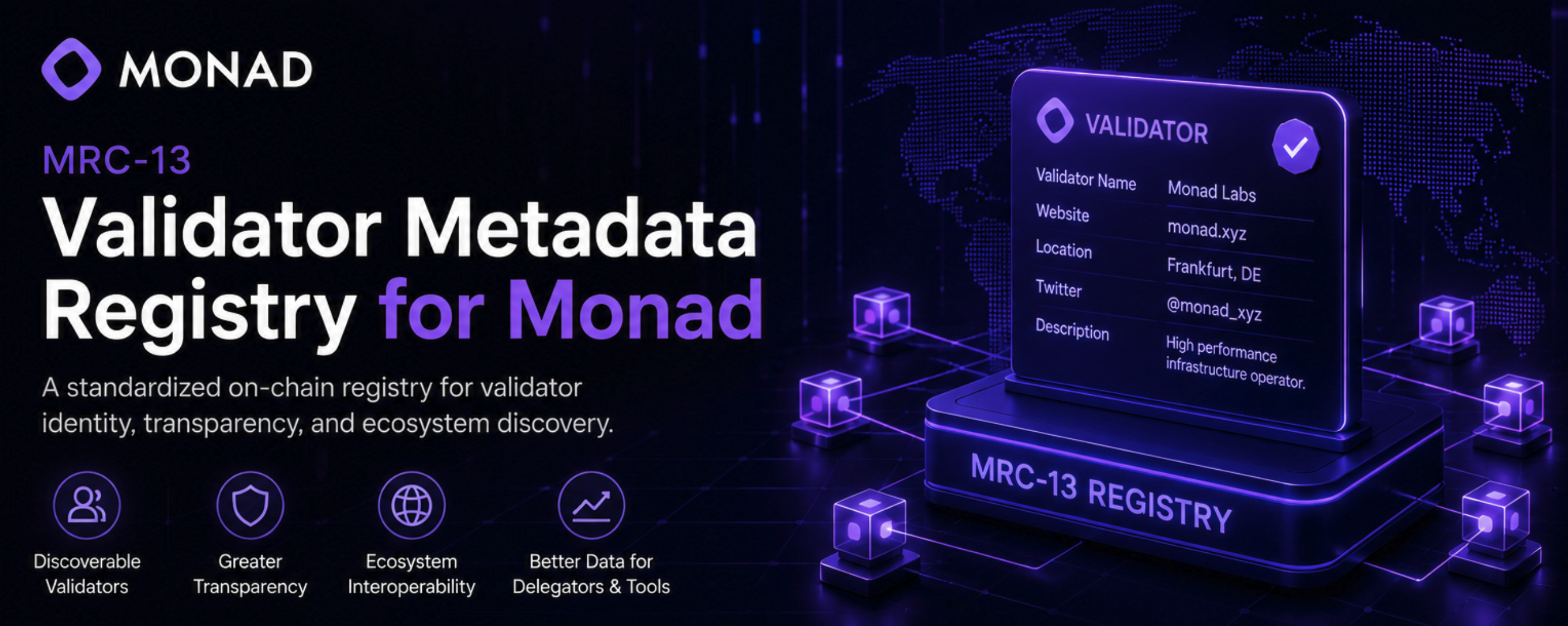
Monad MRC-13 Proposes a Validator Metadata Registry
Why a registry matters
MRC-13 is a governance proposal with a deliberately simple surface area: a standardized validator metadata registry. It does not change consensus, staking rewards, or throughput, but it targets a problem that grows quickly as validator ecosystems mature.
The discoverability gap
From the protocol's perspective, validators can be represented by addresses, public keys, and node identities. From the ecosystem's perspective, that is thin context. Delegators, explorers, staking interfaces, and analytics tools need to know who operates infrastructure, where it is represented, and how it can be verified or contacted.
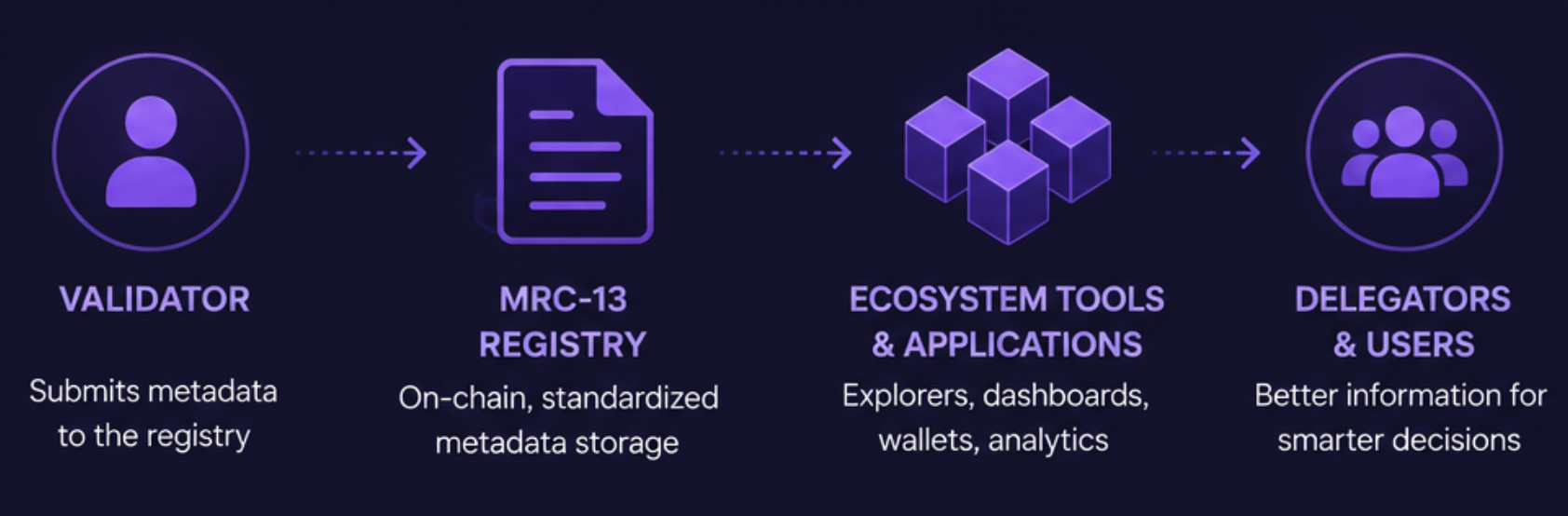
What MRC-13 adds
A shared registry would let validators publish structured identity and descriptive information, including names, websites, logos, descriptions, social channels, contact details, and operational metadata. Instead of every dashboard maintaining its own partial database, Monad applications could consume a common layer of validator context.
Why timing matters
Timing is the strategic piece. Monad is already discussing broader validator participation, VDP growth, MIP-9 active-set expansion, and greater geographic diversity. Discovering 20 validators is easy enough; discovering 200 or 300 requires a standard that can scale with the operator set.
Why it matters for Monad Geo
For Monad Geo and similar infrastructure analytics, MRC-13 would improve attribution quality. A metadata layer can connect validator identity with geography, provider distribution, and ecosystem contributions, giving delegators and operators a more transparent view of the network they are choosing to support.
- MRC-13 proposes a standardized validator metadata registry for Monad.
- Validator metadata would improve delegation transparency, explorer UX, and operator discovery.
- The proposal becomes more important as Monad moves toward larger validator sets and wider VDP participation.
- Monad Geo-style analytics would benefit from a shared identity layer that links operators, locations, providers, and contributions.