

FLOP opened its public Testnet on 24 November 2026 with six founding validators. On 26 November, it published a manual pack for GPU miners. That gave operators a documented way to join the new chain and serve a model, from checking the network identity to qualifying for the gateway. It also raised a practical question. Would a card that cleared the published memory floor actually start the model at the settings shipped with the pack? Testnet network profile · FLOP miner guide
The chain is running and scoring is still ahead
The opening phase gives operators a chance to get their software running and check how it behaves. FLOP’s opening FAQ still described the network as unscored on 26 November. Voucher earning begins at a future finalized activation block that FLOP will announce publicly. The FAQ gave no block or date at this check, and work completed before activation earns no retroactive credit. FLOP opening FAQ
This follows the Devnet rehearsal covered in our earlier articles. Testnet has its own chain identity, account and state. Start with a dedicated Testnet miner account and a fresh data directory. Devnet stake, sponsorship, registration, calibration and work history stay on Devnet. The operator profile publishes the expected Testnet genesis hash, which you can compare against block zero from the public RPC before any signing. Testnet network profile · Opening FAQ · Earlier Devnet guide
From the miner pack to the gateway
On a supported Linux host, the miner has two services. The worker handles sessions, signing and calibration. The GPU backend loads the model and serves inference using vLLM and TOPLOC, which captures evidence about the computation. The manual Testnet archive is unsigned. Compare its SHA-256 with the value published by FLOP before extracting it and use the current manual for release compatibility and pinned images. FLOP miner guide
Check the model profile before planning the rental. The pack defaults to a specific Qwen3-8B checkpoint in BF16. The registered hash identifies the model contents, and the decode policy binds the serving limits, including context length. The policy resolver checks that the chain allows the policy for that model. It then supplies the serving parameters used by the backend. A healthy backend should report the expected measured model identity and policy and finish startup. Testnet model and policy guidance
The official manual sequence creates the account, checks live sponsor limits and requests sponsorship before fetching and starting the model services. Sponsorship can register the miner and supply locked test stake within the published limits. A sponsored miner still has to calibrate. Its worker declares the GPU, publishes its signed key and answers calibration jobs so the chain can accept a capacity cap. FLOP can reclaim automatic sponsorship if calibration misses its grace period. Opening FAQ · Sponsorship and calibration guide
Gateway admission comes after those checks. FLOP says the gateway looks at finalized state for an active registration, accepted calibration and a bond sufficient for that capacity. The public HTTPS endpoint also has to answer a signed challenge with a ready proof. When a route becomes eligible, a completed inference request and a finalized settlement are still separate things to verify. Gateway admission guide
Where the RTX 3090 ran out of room
On 26 November, BitCtrl ran the backend by itself on one GeForce RTX 3090 with 24,576 MiB of GPU memory. It used miner-vllm-toploc v0.1.505, the default 0.90 memory setting and the pinned 40,960-token Qwen3-8B serving profile. The card cleared the manual’s 23,774 MiB floor and the weights loaded, using 15.27 GiB. vLLM then failed during startup while allocating the KV cache. FLOP miner guide · Public RTX 3090 reproduction
The KV cache holds attention data from tokens the model has already processed, so the model can reuse it as it generates an answer. It needs GPU memory alongside the weights and the inference engine’s other allocations. At these settings, vLLM reported 1.62 GiB available for that cache and 5.62 GiB needed to serve a request at the full context limit. The gap was 4.00 GiB. Public RTX 3090 reproduction
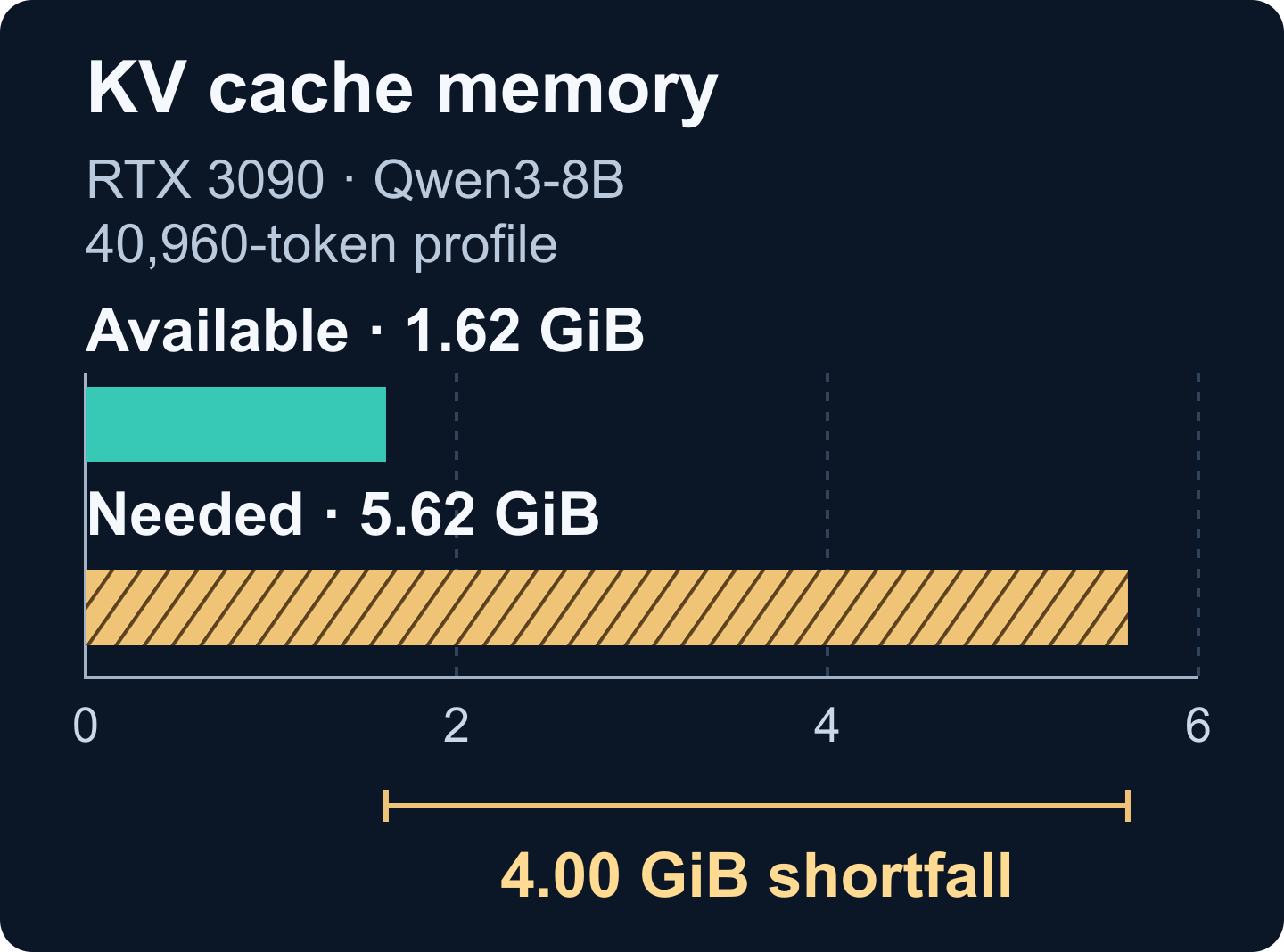
The original issue describes a separate operator’s RTX 4090 and reports a similar startup failure under the pinned serving profile. The figures in the chart belong to BitCtrl’s RTX 3090 run. That test ended at backend startup, before sponsorship, registration, calibration, live routing or settlement. Independent RTX 4090 report · Public RTX 3090 reproduction
Check startup before relying on sponsorship
For an operator about to rent hardware, BitCtrl recommends a backend-only startup check on the exact GPU, image, checkpoint and context limit before relying on sponsor capacity. This is a preflight based on the reproduced failure. FLOP’s guide remains the reference for the official onboarding sequence. Use the supported profile when checking readiness, and treat any policy change as a separate configuration to validate. FLOP miner guide
Issue #1492 remained open and marked for triage when checked on 26 November. A documented release adjustment and a successful repeat on the RTX 3090 would each need their own evidence. Public issue #1492
- FLOP Testnet opened on 24 November. Voucher scoring waits for a publicly announced finalized activation block.
- The 26 November pack takes a miner through sponsored registration, calibration and gateway admission as separate checks.
- On the pinned Qwen3-8B profile, BitCtrl’s RTX 3090 had 1.62 GiB of KV cache space and needed 5.62 GiB.
- Check startup on the exact card and supported profile before relying on sponsorship for a pilot.