


BitCtrl Monad Mainnet Validator Downtime Postmortem
August 25, 2026.
BitCtrl's Monad mainnet validator experienced approximately 60 minutes of downtime following two separate but connected infrastructure events.
The initiating event was instability on a datacenter network device. Restoring that device required a hands-on technician and a manual restart. The resulting server reboot then activated a previously downloaded Linux kernel update that had intentionally not been placed into service. That kernel, 6.8.0-138-generic, is inside a range now documented by Monad as incompatible with the node's dataplane buffer-ring initialization.
Once the kernel was downgraded to 6.8.0-134-generic, Monad BFT started normally and the validator returned to operation.
This report explains the incident chain, impact, response, technical diagnosis, and the controls being added to reduce the chance of recurrence.
Service Status
| Field | Status | | --- | --- | | Service | BitCtrl Monad mainnet validator | | Incident date | August 25, 2026 | | Start | 14:46 local time | | Recovery | Approximately 15:46 local time | | Total impact | Approximately 60 minutes | | Current state | Restored and operating normally | | Primary trigger | Datacenter network-device instability | | Secondary trigger | Reboot activated incompatible Linux kernel 6.8.0-138-generic |
| Resolution | Downgrade to 6.8.0-134-generic and restart Monad services |
All operator timeline times below are expressed as local CEST (UTC+2). The supplied system journal timestamp is reproduced exactly as recorded by the host and may use a different timezone configuration.
Incident Timeline
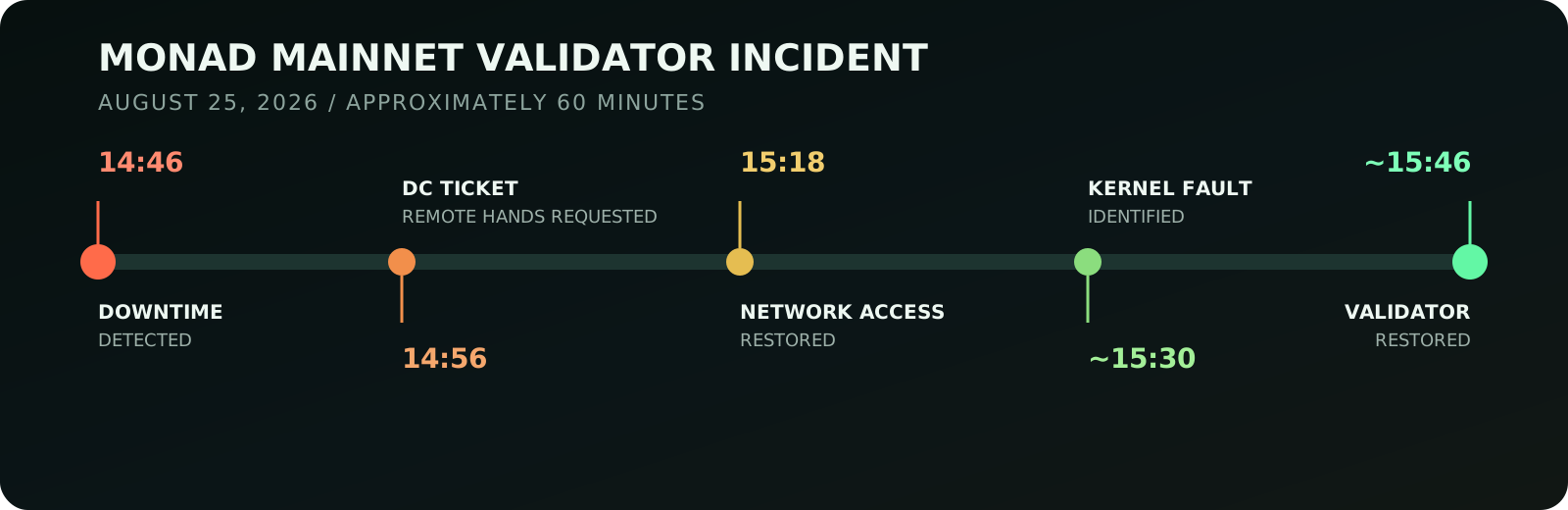
The external network fault was resolved first. The reboot then exposed a separate kernel incompatibility before validator service could be restored.
| Local time | Event | Response | | --- | --- | --- | | 14:46 | Validator downtime and loss of node access were logged. | Remote connectivity and node availability checks began. |
| 14:56 | Repeated attempts to access the server were unsuccessful. | A datacenter ticket was opened and a hands-on technician was requested to inspect the network path. |
| 15:18 | Datacenter network access was restored after manual intervention on an unstable network device. | The server and validator stack became reachable again. |
| After 15:18 | Monad BFT would not start after the reboot. | Soft reset, Monad hard reset, and node reinstallation were attempted while the failure was investigated. |
| Approximately 15:30 | The failed to create buffer ring signature was recognized as a kernel compatibility issue. | Linux was rolled back from 6.8.0-138-generic to 6.8.0-134-generic. |
| Approximately 15:46 | Monad BFT started and block synchronization returned to normal operation. | Service health and validator progression were verified. |
The final two timestamps are approximate because the incident records establish an overall outage of about 60 minutes rather than an exact second-level recovery time.
Event One: Datacenter Network-Device Instability
The incident started outside the Monad software stack. At 14:46, BitCtrl monitoring recorded downtime and remote access to the server failed. Multiple connection attempts did not restore access.
At 14:56, BitCtrl raised a datacenter ticket and requested hands-on inspection of the network equipment serving the host. The provider later supplied the following explanation:
Dear Client, We observed unstable operation of one of the network devices, which may have resulted in a temporary interruption of access to your server. At the moment, all your services are working properly. We apologize for the inconvenience.
At 15:18, network access returned after the onsite technician manually restarted the affected device. That resolved the external connectivity failure, but it exposed a second issue on the server itself.
Event Two: Reboot Activated an Incompatible Kernel
A Linux kernel update had already been downloaded to the server but had not been activated. BitCtrl was aware of the kernel compatibility concern and had deferred the upgrade. The emergency recovery sequence following the datacenter network failure nevertheless caused the server to reboot into 6.8.0-138-generic.
Monad BFT then failed immediately while creating the dataplane's buffer ring. The journal recorded:
Aug 25 13:30:18 monad-node[3298]: thread 'monad-dataplane' (3326) panicked at monad-dataplane/src/udp.rs:296:10:
Aug 25 13:30:18 monad-node[3298]: failed to create buffer ring: Os { code: 22, kind: InvalidInput, message: "Invalid argument" }
Aug 25 13:30:18 monad-node[3298]: note: run with RUST_BACKTRACE=1 environment variable to display a backtrace
Aug 25 13:30:18 systemd[1]: monad-bft.service: Main process exited, code=dumped, status=6/ABRT
Aug 25 13:30:18 systemd[1]: monad-bft.service: Failed with result 'core-dump'.
Primary error: failed to create buffer ring: Os { code: 22, kind: InvalidInput, message: "Invalid argument" }This message was the decisive technical signal. The process was not failing because its ledger needed another reset or because the installation files were corrupt. It was aborting before normal consensus operation because the active kernel could not provide the expected buffer-ring behavior to the Monad dataplane.
Why the Initial Recovery Attempts Did Not Work
After network access was restored, the response initially focused on node state and software recovery. The team attempted a soft reset, a Monad hard reset, and a node reinstallation. None restored block synchronization.
Those actions were reasonable checks after an interrupted host and network event, but they operate above the Linux kernel. Replacing node files or reimporting chain state cannot correct an incompatible kernel interface that prevents monad-bft from starting.
This extended the recovery window. The incident had changed layers: the first failure was in the datacenter network path, while the second was in the host operating system. The same visible symptom, an unavailable validator, therefore had two different causes in sequence.
Diagnosis and Recovery
John from Monad Foundation recognized the buffer-ring failure signature and connected it to the active kernel version. Big thanks to John and the Monad Foundation team for the fast and accurate diagnosis.
The official Monad full-node installation documentation now identifies Linux kernels 6.8.0-136-generic through 6.8.0-139-generic as affected by a known bug that causes Monad clients to fail at startup with this exact error. The documentation recommends 6.8.0-134-generic.
BitCtrl downgraded the host from:
- incompatible:
6.8.0-138-generic - restored target:
6.8.0-134-generic
After the rollback and reboot into the known-good kernel, Monad BFT started successfully, the node resumed synchronization, and the validator returned to normal operation.

The reboot activated an incompatible kernel and broke dataplane buffer-ring creation. Returning to the documented kernel restored the startup path.
Root-Cause Analysis
This was a cascading incident rather than one continuous technical fault.
Primary initiating cause
An unstable datacenter network device interrupted access to the validator host. The fault required onsite intervention because it could not be resolved from the server.
Secondary service-blocking cause
The recovery reboot activated the already downloaded 6.8.0-138-generic kernel. That version falls within Monad's documented incompatible range and caused monad-bft to abort during buffer-ring creation.
Contributing operational gap
The kernel upgrade had been intentionally deferred, but deferral alone did not prevent the image from becoming the selected boot kernel during an unplanned reboot. Knowledge of the risk was not yet enforced as a boot-time control.
Troubleshooting delay
The external network failure made node-state corruption a plausible initial concern. Soft reset, hard reset, and reinstall steps were tried before the kernel signature was identified. A kernel-version check earlier in the second-stage response would have shortened recovery.
Impact
The BitCtrl validator was unavailable for approximately 60 minutes and could not provide normal validator participation during that window.
The incident evidence points to infrastructure availability and kernel compatibility. There was no reported compromise of validator keys and no indication that the event originated from Monad consensus or execution behavior. The node returned to its prior operating state after the kernel rollback.
What Went Well
- Monitoring detected the service interruption promptly.
- A datacenter ticket was raised within ten minutes of the recorded outage.
- The onsite technician restored the external network path 22 minutes after the ticket was opened.
- Monad Foundation support recognized the exact buffer-ring signature and directed the response to the active kernel.
- The known-good kernel rollback restored service without validator identity migration.
Corrective and Preventive Actions
BitCtrl is applying the following controls to make the recovery path safer:
- Pin incompatible kernel packages. Apply the Monad-documented APT policy that blocks
6.8.0-136through6.8.0-139from installation or upgrade. - Set and verify the known-good boot default. Keep
6.8.0-134-genericavailable and confirm the bootloader default before any planned or emergency restart. - Audit pending reboots and installed images. A deferred upgrade must be treated as active risk if the image remains capable of becoming the next boot target.
- Add a pre-start kernel gate. Validate
uname -ragainst the supported range before starting Monad services. A failed check should stop the runbook before node resets or reinstallation begin. - Add post-reboot service checks. Verify kernel version,
monad-bftstatus, absence of buffer-ring errors, peer connectivity, block progression, and validator participation in a fixed order. - Separate network and host diagnostics. External reachability, out-of-band access, host boot state, and Monad service state will be tracked as distinct layers during incident response.
- Retain an escalation path for remote hands. The datacenter ticket template will continue to request direct inspection of network devices when both service and management access disappear.
Lessons Learned
The most important lesson is that an emergency reboot is also a configuration change. A kernel can remain inactive for days or weeks and still become production software at the next restart. Holding the operational rollout is not enough if boot selection is not locked and verified.
The second lesson is to re-establish the failure layer after every recovery step. Restoring network access did not restore validator service because the reboot introduced a different failure. Once the error moved from reachability to local process startup, the response needed to shift immediately from network and chain-state recovery to host compatibility checks.
Finally, exact error signatures matter. The line failed to create buffer ring was not secondary log noise. It was the shortest path to the documented root cause and should now trigger an immediate kernel-version check in BitCtrl's Monad runbook.
Bottom Line
BitCtrl's Monad mainnet validator is operating normally after a two-stage infrastructure incident.
The first event removed network access. The intervention required to recover that access triggered a reboot. The reboot activated an incompatible kernel, and the kernel prevented Monad's dataplane from creating its buffer ring. Recovery was completed by returning the server to the documented 6.8.0-134-generic kernel.
The immediate technical issue is resolved. The operational follow-up is to ensure that incompatible kernel images are not merely deferred, but actively blocked from installation and boot selection.
Source
- The incident began with instability on a datacenter network device, not with the Monad client.
- The recovery reboot activated Linux kernel 6.8.0-138, which is within Monad's documented incompatible range.
- Downgrading to the recommended 6.8.0-134 kernel restored Monad BFT and validator operation.
- BitCtrl is strengthening kernel pinning and post-reboot checks so a deferred update cannot activate during recovery.