


BitCtrl Completes Monad Mainnet MIP-8 Phase C as a Cohort 1 Validator
September 8, 2026.
BitCtrl has completed MIP-8 Phase C on its Monad mainnet validator as part of Cohort 1. The migration retires the legacy slot-encoded timeline and leaves the validator running with page-only storage.
This follows the mainnet activation of MONAD_TEN on September 2 at 14:30 UTC. Page-encoded storage is already canonical across the network. Phase C completes the local storage transition for eligible nodes that continued maintaining both representations after the fork.
For BitCtrl, it closes the sequence that began with page activation in Phase A and continued through the v0.16.1 mainnet upgrade. This is the final storage-migration step, not another hard fork or a newly announced client version.
What Changed After the Hard Fork
Before MIP-8 activation, nodes prepared a page timeline alongside their existing slot timeline. That Dual-DB arrangement allowed the new representation to be built and maintained before the network began relying on it.
At the fork, the page timeline became canonical: its state root is the one used by the network. The slot timeline became a shadow, but remained on disk and continued receiving updates while Dual-DB mode was active.
That distinction matters. The fork changed which representation the protocol used; it did not automatically remove the other database timeline.
The official migration guide separates the work into three stages:
| Stage | Network and node change |
|---|---|
| Phase A: page activation | Create and maintain page storage alongside slot storage. |
| Phase B: hard fork | Page storage becomes canonical; slot storage remains the shadow. |
| Phase C: slot decommission | Promote the page timeline to on-disk primary and remove the slot timeline on eligible nodes. |
BitCtrl has now completed that final stage as a Cohort 1 mainnet validator.
One Timeline Instead of Two
Phase C makes the on-disk arrangement match the network's post-fork state. The page timeline becomes the primary timeline, and the legacy slot timeline is deactivated.
The immediate operational benefit is straightforward: the node no longer needs to maintain two encodings of the same advancing state. Removing the slot timeline also reclaims its disk space. The amount recovered depends on the node's database; it should be measured locally rather than inferred from a generic percentage.
This is not a separate throughput upgrade. MIP-8's page-aware storage changes arrived through the protocol activation. Phase C removes the transitional storage overhead that helped make that activation possible.
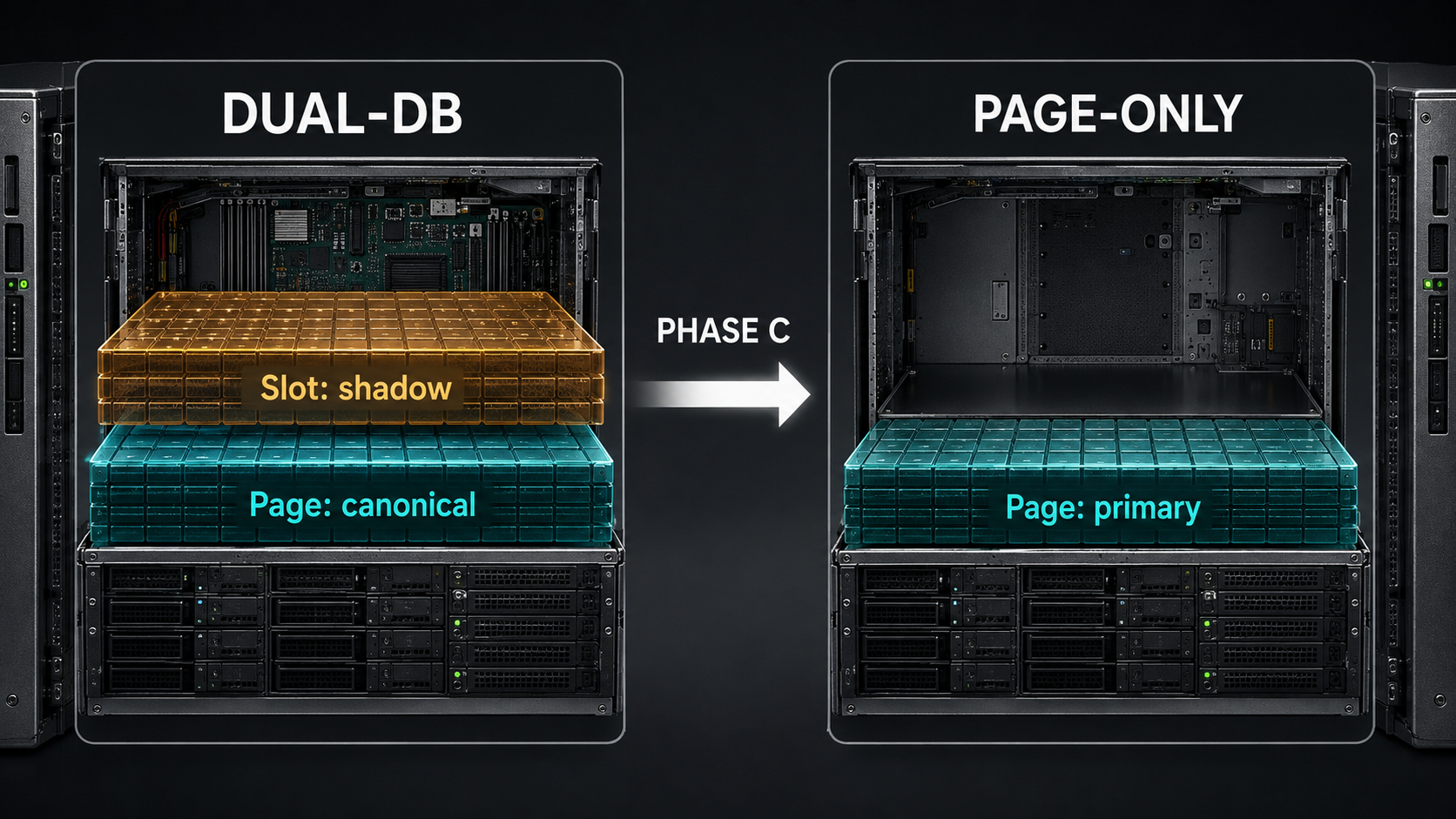
AI-generated editorial illustration. Page storage was already canonical before Phase C; the procedure promotes it to on-disk primary and removes the slot shadow. The banner is also illustrative, not a photograph of BitCtrl's production infrastructure.
The Rollout Still Follows Validator Cohorts
Monad Foundation is coordinating validator maintenance in cohorts. Full-node and RPC operators can perform the eligible procedure at their discretion, but validators should wait for their own cohort announcement.
The schedule in the Foundation announcement supplied for this report is:
| Validator cohort | Announced timing |
|---|---|
| Cohort 1 | Requested to begin; BitCtrl has completed the procedure. |
| Cohort 2 | Tentatively Tuesday, September 8, subject to an MF announcement. |
| Cohort 3 | Tentatively Wednesday, September 9, subject to an MF announcement. |
Tentative dates are not permission to start. Operators should use the latest official announcement before scheduling a restart. BitCtrl's completion does not change the rollout instructions for other cohorts.
Two Exceptions Operators Should Check First
The instruction to retire slot storage does not apply to every node.
State Archive nodes must not run Phase C. These historical full nodes retain the slot timeline permanently to preserve their full history. The State Archive section describes their separate handling. This exception should be checked before applying a general full-node maintenance procedure to an archive deployment.
Nodes hard reset after MIP-8 activation already use page-only storage. They were restored with a page timeline and have no slot timeline to decommission. A hard reset is not necessary just to avoid Phase C; the relevant point is to inspect what is already present.
For a normal Dual-DB node, the official inspection command is:
monad-mpt --storage /dev/triedbThe documented starting state is a primary with kind ethereum and a secondary with kind monad. Here those names identify the storage encodings: slot and page respectively.
Only that starting arrangement is eligible for the documented Phase C procedure. The guide explicitly says not to run it for any other combination. An unexpected topology is a reason to investigate, not to improvise a deletion command.
What Completion Looks Like
For eligible nodes, the Phase C runbook calls for stopping the Monad services, promoting the page secondary, deactivating the former slot timeline, and inspecting the result before restarting.
The expected final topology is:
Active timelines:
     Primary:
        State machine kind: monad
There should be one page primary and no secondary timeline. After restarting, the services should be running and the node should rejoin the network and advance blocks.
The guide also exposes a useful monitoring signal: monad_triedb_migration_phase. Its values distinguish slot storage (0), Dual-DB (1), and page-only storage (2). The monad-status utility can also report the timeline topology.
These are complementary checks. A clean database topology confirms the storage transition; advancing blocks confirms that the node has returned to useful operation. Neither a successful command exit nor a running service alone tells the whole story.
What This Means for BitCtrl and Delegators
BitCtrl's completed Cohort 1 migration moves its mainnet validator out of the temporary Dual-DB arrangement. It follows our Phase A completion and v0.16.1 upgrade, bringing that preparation through to page-only operation.
For delegators, this is maintenance of the infrastructure behind the existing validator. It does not ask users to move assets, change delegation addresses, or disclose keys.
For operators still awaiting their cohort, the remaining job is specific: establish whether the node needs Phase C, follow the published procedure when authorized, and verify both storage topology and block progression afterward. Monad's guide notes that future releases will enforce slot decommission, while State Archive nodes retain their documented exception.
Sources
- Monad MIP-8 migration guide and network activation status
- Phase C: slot decommission procedure
- State Archive node exceptions
- Hard-reset behavior after activation
BitCtrl's completed Cohort 1 migration is operator-confirmed. Cohort dates follow the supplied Monad Foundation announcement; technical requirements follow the official migration guide.
- BitCtrl completed MIP-8 Phase C as a Cohort 1 mainnet validator and now runs page-only storage.
- Page storage became canonical September 2; Phase C removes the slot shadow rather than introducing another hard fork.
- State Archive nodes retain slot storage, while nodes hard reset after activation already use page-only storage.
- Validators follow cohort announcements and verify a single page primary plus continued block progression after maintenance.